Showing posts with label skills. Show all posts

Wednesday, June 08, 2011

beingness

Welcome to the garden.

Elderberry saved from the farm I work at, where they regularly mow it just as it is about to ripen because, and this is incredibly difficult for me to understand, food is not important to them. They've grown up in our garden and will, at some point, be transplanted out. But this year, this is where these are. Sometimes vines, sometimes trees, sometimes whatever, is in the nursery of the circle garden.
The cabbage about to head, the onions doing well, compost in the back there.

Two tomato plant survivors, Italian drying type, which, when we bought the seed several years ago, was supposed to be a determinate but is anything but. These two plants will likely make a forest, and besides that, we can root the suckers for more plants.

The first extra cute cucumber.

Potatoes, hilled.
This would be the largest part of the rectangular garden. The full width would be marked by that wavy row of sunflowers about 3/4 of the way up the photo, and scale shown by the man hoeing at the top. The red corn is at the bottom. You might notice how weedy it is. It gets weeded out a row at a time. Then there are sunflowers, potatoes, more sunflowers, and the white corn. With some melons and such at both ends and other odd places.

And that picturesque row of sunflowers from another angle. White corn to the left, potatoes to the right. That corn right there has not been hilled yet.


This corn right here has been hilled, and beans planted in it. Squash to be added soon.

So, as you can see, this is a lot of what we've been doing. Things are, generally, going well. Everyone has his/her projects/passions and everyone has the things we all do together, or for the benefit of the family, or whatever. Not that there are any clear lines like that. But if one were looking for camaraderie, well, there'd be no better place to find it than in our garden with us all down there.

A sister once commented that her garden was full of weeds. Our garden is full of weeds. But all the food plants need is a small advantage. Maybe I've said this before, but it doesn't have to be perfect. In fact, perfect gets in the way of, well, pretty much everything. The garden is perhaps the least affective place in the world and is thus the most healthy place in the world too.

Thursday, May 27, 2010

Harrowing

So this is the harrow; the spike harrow to be exact. We'd gotten a larger one some years ago and used its spikes (just railroad spikes) and other hardware to make this slightly smaller one for one horse to pull. It isn't that it is difficult to pull but smaller is easier to maneuver and we don't have acres and acres we're trying to do.

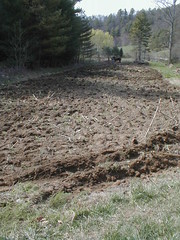
This is the first pass. The ground is rough from the plowing but as that's been several weeks ago, there are also things sprouting and re-rooting. The harrow's job is to even things out a bit, break up clods, things like that. It doesn't have to do it all in one pass and in fact cannot. This is not a machine that plows, disks and lays out your seed bed. Time is your friend with this modus operandi. I mean, what else are you going to be doing with a couple of perfect May mornings? And if you did actually have something else to do, it couldn't possibly be better than harnessing the horse and walking behind him for awhile, taking in that wonder rich smell of the good earth.

This is the second pass the first day. You can see there are still some clumps of perennials that are well rooted. A pass with a shovel took those out. And everything, all over, is getting more even.
This is the rest period place. Although he didn't blow much at all in doing the harrowing. Still, he gets to blow and cool off and rest.

This is the second pass on the second day. We didn't get any photos that really showed the consistency of the soil but it is good and rich although you can still tell the parts of it that have had more manure over the years and the parts that have had less. Our gardens have been worked twenty years and that is really what permaculture is about if you ask me.

And this? This is what we found when we quit harrowing the second day! We're now a three cow family! And then we went swimming. And those are only a few of the pleasures of life on the farm.

Addendum: or What I forgot to say when I got in a hurry:

I finished harrowing and walked the horse up to the house and took his harness off. Donkey didn't follow us right away to the field and so I left the gate open and looked around for the cow. I saw old cow down near the bottom. I took the horse path around the side of the knoll to get a view of more of the back bottom. When I caught a glimpse of new cow, she was facing away from me with her head in the grass like she was grazing but I could see afterbirth hanging. I hurried a bit knowing she was probably licking a baby but still thinking of all the other possibilities -- maybe she'd had it and it was stashed and she was grazing, maybe she hadn't had it yet, etc. When I got close enough to see that it was lying on the ground, flat out on the ground, not moving at all, with her licking it, I thought oh gawd it is dead over and over until I got close enough to see its eye and then I thought that eye is NOT dead! and all the while I was watching how she would react to me coming up to her this soon after birth, and if old cow was going to intrude too, and if either one of them was going to feel threatened by me. Old cow stayed back for a good while, new cow was a little concerned about my presence but not much. All the other animals gave the goings on a wide birth until introductions the following day.

Once again I will say that the hardest thing about midwifery is not interfering. Yet it is also the most important thing. Make sure nothing goes wrong but don't cause anything to go wrong yourself.

Thursday, May 20, 2010

political interlude

"The current crisis facing the euro is the biggest test Europe has faced in decades. It is an existential test and it must be overcome ... if the euro fails, then Europe fails," said German Chancellor Angela Merkel.

Finally, a leader says something honest. Or more honest than anything any other leader of anything has said. No surprise she's from the least socialist country in the EU, while the "bailout" went to the most.

And it is more than an existential test; it is an existential crisis and the truth of the matter is that the existence has shifted, changed, never to go back, so all the looking for "the recovery" and "getting back to the way it was" are whistling past the graveyard, covering the ears and singing "lalalala". The currency almost has no option but to break what with all the printing going on.

So the questions to ask yourself are these: what will I eat, where will I live, how will I keep warm?

Husband and I were out yesterday. I couldn't believe the building going on, with empty building right beside, but it was the new cars on the lot that got me. "I can't believe they still make new cars," I said. "We could go twenty to forty years without a single new car being made."

"And imagine all the jobs there would be," husband chimed in. "Mechanics and machine shops."

"And people to paint and upholster," I said.

And in real estate, four or five families could live in a McMansion and again, people could be employed gainfully, doing something real, making those monstrosities into functional and efficient living spaces. And every yard, and every median, could grow some food.

It isn't a grim thing, this existential crisis.

Sunday, May 09, 2010

Homesteading

Well, first these little guys came in.

Then we finally worked out a day to do the plowing. Above is where we began and below is the handiwork about 2/3 finished. Of course it is also the handiwork of years adding to that soil and working it and growing in it.


And then this was a supper -- pan blackened chicken. Not our own chicken but delicious nonetheless. Must do it outside to do it right.

Soon the rectangle garden will be harrowed and then planted. Perhaps this will be the year we'll actually harrow it in the fall and plant a cover crop and all? I never actually feel badly about it as the weeds make the cover crop but it might be nice to deal with fewer weeds?

All this took place in the past week and here it is Mother's Day before I get it posted and I just have to say that I am so glad to be in this place, with these people, to grow these roots and these wings.

Thursday, August 14, 2008

A Different Stripe

These are the things my life is taken up with: discussions about goat and chicken management, putting up food and making the staples and what’s for supper and washing dishes, keeping the fire going for the smores, lots of other similarly real and productive endeavors, and, today, bovine AI.

AI = Artificial Insemination

Now, years ago I did this, actually helping to collect, examine and insert the semen . . . but on a horse farm. And years ago, things were done via palpation and now ultrasound has taken over. Where they used to palpate for follicles and pregnancy checks, now it is ultrasound. And that was horses, not cattle, so my experience is worth even less.

Hey, did you know there were such things as traveling semen salesmen? And sexed semen? I mean, until about yesterday it hadn’t occurred to me to wonder about such things, but there are. There’s also this guy, on a farm a good ways from here, who is willing to come all the way here to inseminate my cow basically as a favor to me. And he doesn’t know me at all. I went to his place today to pick up prostaglandin in order to induce her cycle so as, hopefully, to be more ready to “catch” her. His place is HUGE, more than 400 Holsteins.

I got a paper that listed sexed semen from different bulls with all these numbers telling you how much milk fat, protein, mastitis cells, numbers of lactations, and a whole lot of other things that the bulls offspring have on average. I am like, boys, you all know way more about this than I do. They said, oh, then you are in trouble. Yes, the bulls are fascinating and the men are hilarious.

What I like the very best is the milieu, the culture, my culture. They are willing to do me a favor and to give me a hard time while they are doing it. A girl can appreciate that.

Maybe next time I’ll say yes to their invitation to join them for lunch.

Tuesday, August 12, 2008

100 Species

ok, so my friend La started an unschooler's network and I came upon this idea there. It came originally from scsours (is that enough links for you yet?), inspired by a not quite quote stating that few people can name 100 species growing in their neighborhood. I bet that's true, that few people can do it.

Well, I can do that and I can do that off the top of my head. And these are all wild or at least naturalized and not planted by us.

Trees
oak (then there's white oak, red oak, black, etc)
maple (hard rock, sugar, etc)
hickory
poplar
holly
pine (white, yellow, black, etc)
hemlock
wild cherry
sourwood
cedar (Virginia Juniper)
locust (white,black, honey aka thorn tree to me)
gum
beech
pine (white, black, yellow)
willows (common, weeping, etc)
ash
walnut
buckeye
butternut
redbud
spicebush
dogwood
sassafras
mulberry
wild plum

Fungus (one's I've positively identified)
jack-o-lantern
dry land fish
anamita
algaric
puff balls

Grass and weeds and flowers and herbs
fescue
black eyed susans
yarrow
queen ann's lace
butterfly weed (pleurisy root)
poke
milk weed
iron weed
stink weed (aka thorn apple, jimson weed)
joe pye weed
jewel weed
nettles
solomon's seal
false solomon's seal
golden rod
rag weed
rag wort
all the docks (burr, yellow, narrow, speckled etc)
all the plantains (english, common, etc)
dandelion
chicory
poison hemlock
cat tails
wild blackberries
wild raspberries
dog roses
poison ivy
ferns (many types)
fairy pine (ground cedar)
lady slipper
tennessee iris
indian pipe
squaw root
pennyroyal
whirled loosestrife
triliums (birthroot, brown and white)
blood root
clover (red, white, ladino)
virginia creeper
possum grapes
comfrey
agrimony
ground ivy
smart weed
purslane
wild mustard
wild ginger
pipsissiwa
tea berry
mistletoe
water cress
upland cress
nightshade
horse nettles
horse mint
peppermint
spearmint
anemones
wild strawberries
cinqfoil
huckleberry
thistle (milk, blessed)
passion flower (maypop)
mayapple
jack-in-the-pulpit
violets (purple and white)
pearly everlasting
lobelia (siphilitica)
cardinal flower
lobelia inflata (indian tobacco)
mugwort
boneset
mullein
green briar
wild lettuce

I think that is more than 100, and I didn't count the various kinds of a thing that I can distinguish and which often have different uses -- well, except those lobelias there, the inflata, siphilitica, and cardinal. I'm guessing we could do 400 or 500 if we took a notebook and kept a list and counted domestic things we plant and maybe more if we did it through a whole year so that you get the early stuff and the late stuff.

Of course, I have an advantage in that I live in an incredibly ecologically diverse place, and I've lived here forever. And I've paid attention and am very present to my environment.

I bet a few people I know can do this off the top of their heads too -- including thingfish, Wayne, and Jim. Cielo and Alecto -- how about you for the girls? It isn't that I doubt the rest of you, but, well, maybe I do doubt you. So put me in my place and show me what you know! And any of you who want to learn 100, or play by scsours rules instead of mine, have a lot of fun with it!

Tuesday, April 08, 2008

Horse Drawn Goddess Comforts

Today we started growing next winter’s food.

We’d already started growing this years food. Fava beans and peas are up. Lettuce and radishes and spinach are darn near close to eating. And there are green onions and green garlic big enough to eat now. And some wild greens big enough to eat (the mustard is flowering already).

And we are, of course, still eating last year’s food -- tonight’s supper is french fries from our trying to sprout potatoes. The french fries are soft and very brown (the starch is turning to sugar) and absolutely delicious. And there is corn and all the preserved food.

But today we plowed the corn and potato field.


Before
Originally uploaded by Contrary Goddess.


After
Originally uploaded by Contrary Goddess.

I had the best time. First I got the horse out and fed him where I groom him instead of in the field. Then I spent time just grooming him, and working a touch on his feet. Oh, is he shedding. And every year I find birds nests made out of his hair. Then it was harnessing him and trekking to the garden with the whole family (and the donkey who will not be left behind).

(The kids had some chores and did things to help us but mostly played in the creek all day -- it's a tough life being homeschooled.)

And then it is in the field and working and paying attention to the furrows and to the condition of the horse (but not to the plowman or the driver of course). A little more than half through is a rest break for the horse. Shade and grass and water. Husband brought me a sandwich I had leftover from working yesterday and a soda because I forget to eat and it is not pretty. Then we finish. Horse is so good but he was ready to quit too.

After plowing I took him to the bee creek and he took a draught, but I didn't allow too much of course. I'd unharnessed him already, and took a bucket with me, and began pouring buckets of water over him. It is as close to a bath as he's ever gotten. I watched the sweat wash off with the cold mountain creek water. His feathers were full of burdocks so I combed those out, and used a little mitt thing to massage him with, and then combed him because his hair is so long the comb might be the only thing to reach to his skin. More water all the time, one bucket at a time.

People who wash horses have seen this, but a soaked to the skin horse can get awfully slick. And like I said, this is as close as he gets to a bath and obviously he hasn't had this done since last summer sometime and it was just such joy to watch the water pour off of him and the smoothness of his hair over his muscles. And he was obviously enjoying the treatment too.

When I finished with that I walked him back to the house. Husband took the harness up for me, bless him, or I would have had to put the harness back on the horse to get it to the house. Back at the house I brushed him some more.

He's still shedding. And I bet he'll be a bit stiff and sore in the morning. Like me. But oh, this is fun. I do not find a world without machines to be a depressing prospect at all.

Then I took a bath myself and ate french fries.

Friday, February 15, 2008

Valentine's Pictorial


Stance and Form
Originally uploaded by Contrary Goddess.

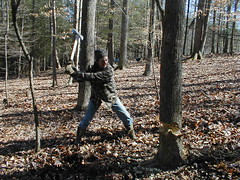
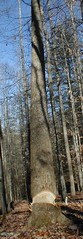
First, I chopped a tree down. There are more photos of this of flickr if'n you're interested. I didn't do it ALL by myself but this is something I've been wanting to do, to know that I could do. And it is thrilling. I was sweating. It was cool.

For supper it was

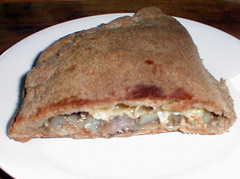
Cabrito stromboli
Originally uploaded by Contrary Goddess.

cabrito stromboli, made with the loin from the white wether. The kitchen was really rocking as I made the crusts (it takes six big stromboli's to feed our family, which is the equivalent of two loaves of bread for the crusts), husband made the filling, and daughter made

WW butter sugar cookies
Originally uploaded by Contrary Goddess.

whole wheat butter sugar cookies using lots of red dye!

A great time was had by all.

Wednesday, February 13, 2008

Winter's Dazey


Dazey guts
Originally uploaded by Contrary Goddess.

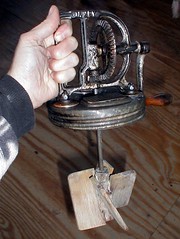
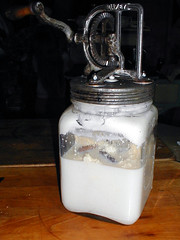
We have an old Dazey butter churn. The thing must be near 100 years old. I got it from my mother but it isn't an ancestral churn -- my ancestors used dasher churns.

We've used, quite actively, this churn for years now. The top "works" of it were just riveted onto the top and turning it hundreds of times for each pound of butter creates some stresses at those attachments. Even before we started using it, stress cracks were developing and after years of our use, I was getting concerned about them.

Thankfully one of our good friends is a metallurgist. Now, ages ago when MadCap put together a virtual community of homesteaders, people offered up "skills" like "cook" and "networker" and "counselor". Let me tell you now, if you are not able to cook, network a couple computers together, or counsel a friend to not be stupid then there is no hope for you. Skills are more real, more concrete, and more rare than that. Like looking at an ancient butter churn and knowing what to do to fix it. Although in the end, if it came down to it and we didn't have this friend, we would have had to figure it out ourselves.

After coming out here and sipping some excellent Irish Whiskey and playing some music and solving the world's problems with us, our friend took the churn top home with him. He took it apart, analyzed it, and fixed it for us. Turns out the shaft was crooked so he straightened it. There were lots of jokes about this. There was a pin that was about worn in two so he replaced that. And where the top was cracking, he reinforced it on both sides with copper washers, soldered it with tin, and replaced the rivets with a small bolt and an elastic threaded nut that won't work loose. New meets old, modern meets ancient, useful meets useful.

Dazey w/ butter
Originally uploaded by Contrary Goddess.


He returned the churn to us before we were out of fresh butter. Thanks friend.

Friday, January 18, 2008

If I Knew Now What I Know Now

I’ve seen that one of my very best life skills is the ability to ask questions. Lots of questions. Even uncomfortable questions. And the ability to see options, possibilities, a lot more options and possibilities than the average joy seems to be able to see. But that ability starts with the questioning.

I didn’t always do this. I probably always had questions to ask, but discerning the most relevant questions is a trick. And being willing to hear and sift through whatever answers you get is difficult too. I think when I was a lot younger, I didn’t ask questions because I didn’t trust the adults around me because they all had agendas for me and I knew what they’d answer, or how they’d disapprove of my questions even. So there were opportunities I didn’t see and questions I didn’t ask, from big to small. One that I remember was that I had access to a ton of real experts when I bought my dressage saddle and I didn’t ask them -- and I didn’t buy the best possibility because of that. That’s a small thing. There were possibilities that I didn’t see because of the default thinking like ‘of course you have to go to college’. Stuff like that.

I first started thinking about asking questions, and the quality of those questions, when I was twenty. It was in this moment of suspension in the midst of the rent in my life when I went fishing with a college English professor who felt sorry for me (and my parents no doubt). I’d never ever fished. We were just at a water hazard on the golf course in the Valley and the lesson started with basics such as ‘this is a hook.’ I got my hook caught on branches and stuff a few times and then, suddenly, Ron had a fish on his line. He reeled it in, showed me how to get the hook out, and released the fish, and I said, “How did you do that?” “What?” he asked. “What exactly did you do to catch that fish?” I asked.

And he said, “Wow. That’s a good question. Most people don’t ever think to ask that.” Well, more’s the pity, but it seems he was right about how few good and relevant questions people are willing to ask but it is something that I never forgot: when someone is doing something you want to do, ask them how they did it. And don’t let them off the hook. Likewise, when someone’s life is bearing fruit you don’t want, don’t do what they are doing. Despite what people might say about preferring to focus on the things they want to do, it is just as important to be aware of what you do NOT want to do.

So, what are some of the important questions I’ve managed to ask? Well, perhaps most important is, “What do I really want to do?” It is important to ask that one in this moment but also long term. And frankly, it is often a difficult question to answer. And it is often as not answered by what you don’t want to do. Especially long term, pay attention to what you don’t want. “Who do I really want to be?” is perhaps the most spiritual question there is, way more than who is God or why am I here and other questions that there aren’t any real answers to. Or it could be phrased, “How do I want to be?” “What is really important?” is another, and a place where I think people screw up most often when they say one thing is important but what they do is another thing. What is really important to them is what they actually do no matter what they say. The law according to CG.
It is also important to pay attention to who you are asking. Like I wouldn’t really ask Al Gore how to lessen my carbon footprint because it isn’t anything he is personally the least bit familiar with. I only know one other person (except my grandparents who are all dead) who has actually hand-milked a cow and that was the person I bought my cow from. What people know “from the boys on the internet” is far less reliable than what I know from my grandparents’ example. I pay far more attention to what I know from my experience than to what other people think they might know from their thought experiments.

Another really important question is, “What is happening, really?” Again, discernment is important but if you don’t know what is happening around you, how can you prepare for it?

“What are the options I haven’t thought of yet?” I guarantee you that if you don’t have a solution to a problem that works yet, you haven’t yet thought of enough possibilities. There are always more. Always.

There are more important, relevant, incisive questions too. But it is time for supper which is itself an important question (as in "What are we having for . . . ?") which tonight was answered by baked acorn squash stuffed with onions and butter and topped with cheese, canned McCaslin green beans, and pickled beets. With a pone of corn bread of course. And a big glass of milk. Off the place.

It has been cold. It snowed again. Life is largely cutting wood, feeding the fire, milking, making bread, keeping warm, dealing with mud, feeding animals. But there is a greenhouse taking shape in the garden. And plans for plowing when it dries off a bit. And new thoughts on fencing and barns and the like. Sure, it is mud season but also movie season when we rent cheap videos which also makes it popcorn season. It is seed catalog season and remembering what you learned last year season. It is, no matter how cold it is, knowing that the sun is coming back season, and appreciating long sleepy nights season. It is the season to remember, and the season to dream.

Wednesday, December 26, 2007

All I Ever Wanted

or life's gift to me


tree stuck
Originally uploaded by Contrary Goddess.

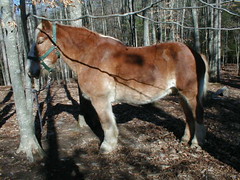
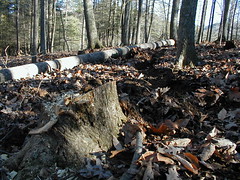
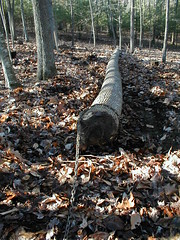
This was the tree. You can't see the top in this photo, but it was big, tall, and exceedingly dead. Which spells dangerous. When cut down it could fall 350 degrees clear but chose to twist into another tree and hang. Luckily, the horse could safely get it down.


the Duke
Originally uploaded by Contrary Goddess.

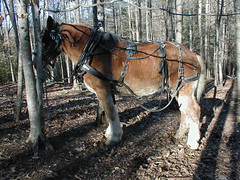
Today was the day. Any day I get to play with the horse is a good day. And he thought it was good when he saw the harness coming instead of the bareback riding pad.


horse harnessed
Originally uploaded by Contrary Goddess.

So add harness, a chain around the butt end of the tree, a singletree, a husband to hook and unhook him while I teamstered, a bunch of tugs, first in one direction, then in the other, and finally it came down. It took more than an hour. The horse was frustrated because he likes to pull, not tug, but this was a tug sort of job and he did great.


stump & log
Originally uploaded by Contrary Goddess.

And so there is the stump and the log, finally. You can see from the angle of the stump why it had to be pulled side to side instead of up the hill. Even after it was off the stump, it was still hung and had to go side to side, and couldn't just go to one side because of other trees in the way. Such is life in the forest.


butt end log
Originally uploaded by Contrary Goddess.

And this is the butt end, with chain. You can barely see that the top end of the log is now tied up between two trees but that is easy to cut loose. He just couldn't pull it any further. And then when he started up our drive with the heavy part, he started slipping and just refused to pull anymore. I figured he knew what he was doing and that we were close enough so I unharnessed him and took him and donkey to the front fields to graze.

All that could be wanted from a day.

Saturday, September 01, 2007

Chicken Butchering

Make sure your tools are ready. You need a sharp hatchet or ax, a place to chop their heads off (for me, this is two nails a chicken head's width apart in a log), a pot of hot water, something to singe with, a clean sink to do the gutting in, and a place to cool them and age them. Keep in mind, this isn't the only way to do this, but it works for me and I've probably done it more than anyone else you know.
Select a rooster. I usually do two or four at a time. One is not enough for our family a meal, and more than four is tiresome without a lot of help. Which you'll see, I have some help for parts of this that really need more than two hands.

Actually, you've selected the roosters the night before last and put them separately and given them free choice water but no food. It is much easier and cleaner to gut something who's gut isn't full.
This is the hard part. Take your warm, breathing chicken and with its legs in your left hand, put its head between the nails. This is a bit of a hard fit. Then you stretch the legs out behind so the rooster is stuck there. Don't worry, he's not there long and if you know anything about chickens, you know they get real calm when held upside down. Then in one determined chop, hit as close behind the nails as you can. Don't be alarmed if the head doesn't entirely sever -- he's dead anyway.

And the first time you do it, you'll swear he isn't dead. He'll flop. I keep a hold on his feet while he does the worst of it. You don't want them bruising if you can help it, and held upside down they bleed out a bit better. After most of the flopping is done, I put him in down (in something usually, it could be a box but right now I'm using a roll of fence wire that happens to be there -- they fit neatly in the woven square and upside down too) and go get the next one. I usually chop two at a time, no more, no less. It just makes the timing work out better.

After chopping the second one's head off, I take the first one and scald him. I've heated this water hot before I came outside, and I brought the water with me then. Its exact temperature matters less than your judgment -- if the water is hotter, hold him in there less long. I think I've never had it seriously too hot because it has to wait on me to kill them. If I'm doing two sets of roosters I probably have two pots of hot water though because I don't think it would stay hot enough through four roosters. Notice how you hold him so absolutely all his feathers are in the water.

The feathers that take the most scalding are the wing and tail feathers so if you can grab them and they come out right away, he's scalded enough. The other feathers will literally come out by the handfull. Strip from top to bottom. After the feathers come out, the pin feathers come out and you have to go back and get those. None of this should be hard. It takes a while and it might feel like it will never get done, but it will. Think about roast chicken or something pleasant.

Here I am going for the wing pit feathers! Look at those scrawny drumsticks! These are not meat chickens (they are "dual purpose" black sex links) and they don't look or eat like it. I won't raise meat breed chickens because I did once. They are not healthy chickens.

Here I have recruited a daughter to help with the last of the pin feathers.

Singing is mostly for the hairs. These chickens didn't have many hairs. Here we are using a fagot of dead pine branchlets. It was windy and we were having a hard time. The flame should be bigger. We used rolled up newspaper on the next one.

Ok. We're inside now and they've been washed off and the feet cut off. He's beginning to get stiff. There is a place right under the anus that you can cut into and not cut anything you don't want to. That's where I make my first cut.

I stick my finger in that first cut and work my way around. With some chickens you can almost pull the anus loose but this one I had to cut. You want a really sharp knife for this so you don't have to use much pressure to cut so you won't cut yourself or the chicken's guts.

Once the anus is loose, I just pull it out some and stick my hand up in and tear the membranes that attach the guts to the inside of the carcass. It is work around, work around, work around, feel, work around, pull a bit, work around. In the above photo I've got the guts started out but I'm now way up in there working the windpipe loose. With the head off, you just pull everything out the rear end. Rinse the bird and put him where it is cool.

These are the edible parts of the guts. They come out attached together. That's the gizzard on the left, the liver in the middle, and the heart on the right. Be careful as the bile duct is attached to the liver and it is a trick to cut out. Not hard. But don't leak bile on anything. Usually I can get it without leaking bile at all. But gosh darned if I can figure out how to describe how I do that. It isn't hard and you can see how to do it when you see it. Just cut out a little of the liver to make sure you don't cut into the bile duct.

I just take the heart out of the membrane and maybe trim the top of it if it has any length of blood vessel on it.

Now, the gizzard. This is a delicacy in these parts. The gizzard is, essentially, a birds teeth -- where it grinds its food up. So this muscle is strong. Both sides of the gut will be attached to this and you have to cut them loose. The gizzard is a flattened oval shape and you need to cut around the longest circumference. But not all the way around, just 3/4 or a little more.

When you do and you open the gizzard up, you will find stuff. This one had hay it looked like, and sand which is what they've had for grit. I dumped this blog out (in the chicken bucket, not in the sink).

Now what you have is the gizzard opened up. Rinse this then take off the inside membrane. Very easy to do. You can save the innards until you have enough for a whole innard meal or you can fix it when you fix the rest of the chicken. We plan to roast these chickens and will just roast these innards with them.
There was a time when people were a tiny bit more in touch with their food than now and they knew that aging meat was a good thing. Most meat needs to be aged. Period. And I acknowledge that "aging" is a euphemism for rotting, just a bit. The meat drawer is a good aging chamber. I put the chickens in a light brine (I don't measure, just water and salt) and put them (in a bowl because the bags always leak eventually) in the meat drawer. Minimum of two days. I don't know what the maximum would be but I'd guess a week wouldn't hurt them. We usually end up eating them the third day.

There ya have it. There is something deeply spiritual about this whole process. I know it doesn't come through in the description but it never fails to move me. We cared for these chickens every day for 16 weeks. It was breathing in my arms. It looked at me as it was dying. I thanked its spirit. I learned things about it from how tight its innards were to what its gizzard held. We raised it, we killed it, and we will eat it consciously, deliberately, examinedly, and with principle.

Monday, June 04, 2007

Good Directions

Sometimes I run into a person I haven’t seen in awhile and the conversation pretty much always goes like this:

Them: What are you up to?

Me: Same thing as always. How about you?

Them: Well, I’m divorced/remarried, moved, new career, new degree, new focus, new passion, different in how many ways.

Now, the truth of the matter is that a lot is different in my life too. Life is different, for example, with children than without them, and different again with older children instead of younger children. The garden is different the first year than the fifteenth. Every year we try new things, emphasize different things, encounter different levels of failure and success in our endeavors.

But

My life has a direction. And really always has. No matter the detours, the wrecks, the sidetracks, the false starts, the mistakes. And so sometimes I ask other people, what is your direction? And as often as not, they say, “Direction?” Like it never occurred to them. Well, maybe it didn’t. But if you don’t have a direction, how do you get there? I used to do a goal setting piece in experiential learning workshops I conducted wherein I usually said something like, if you are going to take a vacation, what do you do first? You figure out where you are going. If you don’t, you are going to end up at the beach with snow skiing equipment, or in the mountains with only a bathing suit and sunblock. Or you get ready for a week’s vacation and only have money for one night at a hotel.

I’m always doing the same thing as always. But every single year is different. And there are always refinements.

I highly recommend having a direction. And knowing what it is.

Saturday, May 12, 2007

You Can Do It, Whatever It Is

True enough, I do not come to being able to do this from nothing. I have been around horses my entire life, I have studied bone and hoof structures, I have watched farriers ad nauseum. And I don't do much, really. I don't have to make their hooves perfect, just better; I don't have to do it all at once, but a little at a time. And I have found that doing that, I have pretty much have their hooves in better shape than they ever have been. Not perfect, just better.


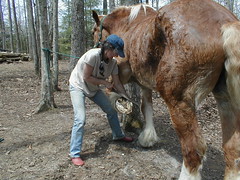
Size Matters
Originally uploaded by Contrary Goddess.

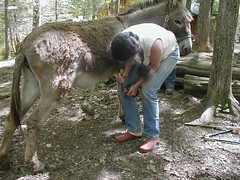
From the size here, you can perhaps see why I do a little at a time. I'm in good working shape, strong, but I can only do two of the big guy's hooves at a time, and only a little at that. So if he needs some work, he just gets worked on often. We built a shoeing stock that the hired farrier used, but I find the process of doing a little at a time and seeing the results then doing a little bit more to work for me right now.

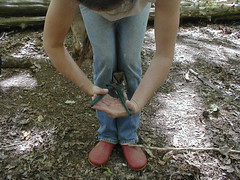
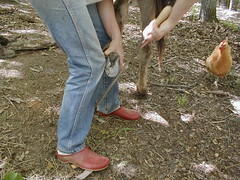
That little tool is called a hoof knife. The only other tools you need are nippers and a rasp.


Hoof Knife, off fore
Originally uploaded by Contrary Goddess.

The hoof knife cleans up, takes off the excess sole, and lets you see what you are doing. I never take off excess frog myself although I've seen farriers do it.


Nippers, off hind
Originally uploaded by Contrary Goddess.

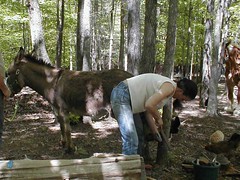
The nippers take off excess hoof wall. There isn't a lot of excess hoof wall on barefoot equines. Still, donkey's feet had overgrown before I started this process and so I do take some off on him. And sometimes on the horse, he'll have a long toe that the nippers help with. Dogs love the trimmings as treats.


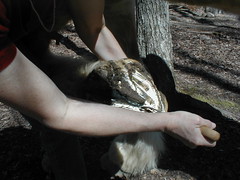
Rasping Rear Near
Originally uploaded by Contrary Goddess.

The rasp takes off more, like a super duper nail file, and cleans up. The things paramount to keep in mind are flatness of the bottom, and "in line-ness" of the hoof, meaning that the outside hoof wall and pastern are at the same angle. Make sure you look at the hoof from the front and back to make sure you don't have one side shorter/longer than the other.


Rasping Tableau
Originally uploaded by Contrary Goddess.


Dirty Girl
Originally uploaded by Contrary Goddess.

There is nothing better in the world.

Ah, but here is the cautionary part of the tale:

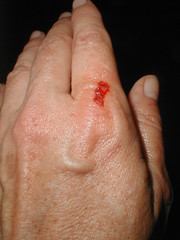
Rasped Knuckle
Originally uploaded by Contrary Goddess.

What the rasp will do to anything that gets in its way. That hoof knife is really sharp too, so don't go and slip with it, at least not toward yourself. And it really does take a strong back to begin with.

Oh, and I don't feel bad about always coming away bloody either. I've never known a paid farrier who ended a session without bloody hands.