Tuesday, April 14, 2009
Friday, September 19, 2008
The Secret Orchard
I happened to have the local news on and found out that the price of potatoes has gone up. I hollered out to husband, "Hey, we just got wealthier!" Because, you know, we've got potatoes.
We also have these apples. Now, these are from a secret place that I hope only we know about. Well, us and the bears anyway. At first we wondered why there were no apples on the ground. Then we saw one way high up bit in two. With teeth marks. And these odd looking piles of poop. The occasional branch ridden down. And stomped down areas. At first we were thinking other people knew about this secret place but then we thought about the bears. It is, after all, in the bear preserve. We live in the bear preserve. So we hope the bears won't mind too much sharing these apples with us.
Now, each bag you see there represents apples from a different tree. There were a couple more trees whose apples were not anywhere near ripe yet. We plan to go back. But right now this is enough to process. And pack out. The trees are not near anything, including the road. That is a good bit more than a hundred pounds of apples.
We will keep the perfect ones and store them in the cool, probably in sawdust although you could use clean dry leaves. Those will be some eating apples and some of them will likely keep until Christmas or after. The less than perfect ones will become what I grew up calling "apples". Or "cooked apples" if you had to specify. It was also known as "fruit". Anyway, it is just cut up apples, usually fairly sour ones, cooked, with a little sweetening added. And usually a dollop of butter. Just enough water in the bottom of the pot to keep them from sticking. Just stewed. Depending on what kind of apple you start with, the end product differs. My grandparents used "horse apples" that were very sour and sweetened retained a rather sweet-tart flavor and cooked to mush. My mother had three trees with some Winesap sort of apple on them (they were 5 in one trees) and those kept their shape and had a full bodied flavor. I love all of them. I remember my grandparents, sitting under their big double birch tree, with wash tubs full of salt water, peeling, quartering, coring, and slicing the apples. When I'd take my hand to dunk the slices into the water, I could see my grandmother's hand doing the same thing, still holding her knife. After the salt water, you just take the slices, shake the water off them, and put them in freezer containers and freeze. To cook, just put in a pot on some low heat. This is a great breakfast side. Great anything side actually.
We'll also dehydrate as many as we can. We're dehydrating onions and tomatoes right now too.
Oh, and we'll be trying this this year to see if it works or not -- taking the peels and the cores and cooking them with water to make apple jelly. No waste that way.
These are Jacob's cattle beans, dried on the vines before they were picked off. The thing sitting on the handle is a giant sunflower head drying. Tons of those this year too. I'm determined to not let the birds have all of them -- there are plenty of other things for the birds to eat!
Tuesday, August 12, 2008
100 Species
ok, so my friend La started an unschooler's network and I came upon this idea there. It came originally from scsours (is that enough links for you yet?), inspired by a not quite quote stating that few people can name 100 species growing in their neighborhood. I bet that's true, that few people can do it.
Well, I can do that and I can do that off the top of my head. And these are all wild or at least naturalized and not planted by us.
Trees
oak (then there's white oak, red oak, black, etc)
maple (hard rock, sugar, etc)
hickory
poplar
holly
pine (white, yellow, black, etc)
hemlock
wild cherry
sourwood
cedar (Virginia Juniper)
locust (white,black, honey aka thorn tree to me)
gum
beech
pine (white, black, yellow)
willows (common, weeping, etc)
ash
walnut
buckeye
butternut
redbud
spicebush
dogwood
sassafras
mulberry
wild plum
Fungus (one's I've positively identified)
jack-o-lantern
dry land fish
anamita
algaric
puff balls
Grass and weeds and flowers and herbs
fescue
black eyed susans
yarrow
queen ann's lace
butterfly weed (pleurisy root)
poke
milk weed
iron weed
stink weed (aka thorn apple, jimson weed)
joe pye weed
jewel weed
nettles
solomon's seal
false solomon's seal
golden rod
rag weed
rag wort
all the docks (burr, yellow, narrow, speckled etc)
all the plantains (english, common, etc)
dandelion
chicory
poison hemlock
cat tails
wild blackberries
wild raspberries
dog roses
poison ivy
ferns (many types)
fairy pine (ground cedar)
lady slipper
tennessee iris
indian pipe
squaw root
pennyroyal
whirled loosestrife
triliums (birthroot, brown and white)
blood root
clover (red, white, ladino)
virginia creeper
possum grapes
comfrey
agrimony
ground ivy
smart weed
purslane
wild mustard
wild ginger
pipsissiwa
tea berry
mistletoe
water cress
upland cress
nightshade
horse nettles
horse mint
peppermint
spearmint
anemones
wild strawberries
cinqfoil
huckleberry
thistle (milk, blessed)
passion flower (maypop)
mayapple
jack-in-the-pulpit
violets (purple and white)
pearly everlasting
lobelia (siphilitica)
cardinal flower
lobelia inflata (indian tobacco)
mugwort
boneset
mullein
green briar
wild lettuce
I think that is more than 100, and I didn't count the various kinds of a thing that I can distinguish and which often have different uses -- well, except those lobelias there, the inflata, siphilitica, and cardinal. I'm guessing we could do 400 or 500 if we took a notebook and kept a list and counted domestic things we plant and maybe more if we did it through a whole year so that you get the early stuff and the late stuff.
Of course, I have an advantage in that I live in an incredibly ecologically diverse place, and I've lived here forever. And I've paid attention and am very present to my environment.
I bet a few people I know can do this off the top of their heads too -- including thingfish, Wayne, and Jim. Cielo and Alecto -- how about you for the girls? It isn't that I doubt the rest of you, but, well, maybe I do doubt you. So put me in my place and show me what you know! And any of you who want to learn 100, or play by scsours rules instead of mine, have a lot of fun with it!
Friday, July 25, 2008
Canning as a Contact Sport
We finally made it to the u-pick blueberry place on Tuesday. With our crew it didn’t take but a couple hours to pick 5 gallons. Youngest, at 8, was not real happy until he discovered an apple tree he could play under and climb and make into his special place . . . And when the rest of us had had enough sun in the berry fields we joined him in there!
I love this place. The lady is so extremely local. I value that. Ok, I am that too, but I value that. I love my friends from everywhere but it is so rare that someone is from somewhere and is still there and there is a connection to place, a level of knowledge and connection, a culture, that just isn’t there otherwise. And she’s just really nice, asked us when we paid her if we felt like we were satisfied and getting good value for our money. I think she’s gone up a dollar a gallon in the past two years. She was worried that one man had been out picking for a long time and asked us if we’d seen him . . . so we went and found him to make sure he was ok before we left, so she wouldn’t worry. She told us tales of people passing out in the field and her taking chairs to people so they could sit while they picked.
Then on Wednesday husband went and picked four gallons of blackberries. So we had a lot of processing to do. I learned how they make Molotov cocktails from a Professor O’Donnell I met in 1980 when the Troubles were what terrorism meant. They put sugar in them because it makes the heat stick. Canning hot sugar is dangerous. I know that well. Kids have always been banned from the kitchen when we are doing it, and we don’t do it alone.
And we still had an accident today. I was pouring the stuff into the jars and dropped the pot somehow and some sloshed on my wrist and sure enough, it burned the fire out of it. As careful as you are, sometimes sh*t happens. As it turns out, it isn’t too serious and I’m real glad of that. We soldiered on with the jamming anyway and made 30 pints which was 6 batches of blackberry (one of them a partial batch since I dropped it) and one of blueberry and about one third of what we’ll hope to end the year with. We also dried about two gallons of the blueberries, and froze a couple, and ate the rest I guess.
And we’re deciding which days this coming week will be berry picking days.
Posted by
CG
at
6:52 PM
14
comments
Labels: everyday life, food, foraging, pleasures
Monday, July 21, 2008
unto the least of these
All summer I'd been watching them grow. As soon as I knew what they were, I mentioned them to my boss, hoping she wouldn't bush hog them down. Other people at the barn said that field, the back field, the big hilly one with both a pond and a cave in it, almost never got hogged and I needn't worry.
But today when I walked out the back of the barn, I saw immediately. They were gone. I felt like throwing up, honestly, and I think I did cry just a tear or two. There was a hole in my soul for the loss. It played over and over in my head all day.
Elderberries. Just that. Elderberries.
And frankly, if I had them in my pasture, I wouldn't want them there either. A pasture is supposed to be pasture, to grow grass and clover and the like, but if it isn't mowed/grazed or if it is overgrazed (which this is), then other things start happening. Annual weeds, then tougher perennial weeds, then things like elderberries and blackberries, then trees. Elderberries and blackberries are reclaiming plants. If you want to find them, look for disturbed soil, or clearcuts, or abandoned pastures. But don't wait too long -- the best wild blackberries fields are only good for around 5 years and then the trees will shade them out.
I'm just saying I know why he cut them. But I'm also saying that I wouldn't have done it. Food is holy.
People are so disconnected from their food. From everything really. From each other, from birth, from death, from what sustains them, what sustains them really. So disconnected that they can cut down what in a month's time would be food, and they can do it without a thought, and even if you said to them, "this is food," it wouldn't have mattered, except if he'd known I wanted the berries, then I believe he would have spared them for me.
But he wouldn't have spared them for food. And I don't believe he was even slightly aware of their existence. And this is the way it is -- there are it may be so many voices in the world and none without signification is what the Bible says of it. There are so many entire worlds out there and, says I, the oil world has obliterated all knowledge of them. Not solely oil, there have always been the more aware and the less aware among us. But do you reckon Nero was as unaware of where his food came from?
We have scoped out several other elderberry places so all elderberries are not lost for the year. Used to my paternal family reunion was held the third Sunday of August and on the way home from that the elderberries were always ripe and we'd stop in the wide spots in the road and pick them. Maybe a bird will plant some on some ground here for me.
If you've never read the introduction to Tom Brown's Guide to Wild Edible and Medicinal Plants, do. When you can feel this way for the blade of grass . . . .
Posted by
CG
at
8:07 PM
5
comments
Labels: choices, foraging, life, priorities
Monday, April 28, 2008
Dogwood Winter
It is official: we have salad from the garden. Tonight it was a lot of spinach and some lettuce and some arugula and broccoli rabe (which, I swear, is what we hillbillies call common mustard). The first night we managed lettuce from the garden, it was just lettuce on pork sandwiches. But oh it is such a treat to have fresh greens again. We also had a good mess of lambs quarters just the other day -- they wouldn’t have been big enough if they hadn’t been weeds in the greenhouse.
We also have another mess of morels that we’ll probably fix tomorrow, maybe with some of the squash that we still have from last year. And we had a really good rain so there should be more morels. Oh, rain, how I bless rain. It will make the turnips and beets and other things in the garden do nicely.
There are, it may be, so many good things to eat in the world and none of them without signification.
an essentially truthful bastardization of Paul in I Corinthians 14
With our cabrito tamales tonight we had not only salad but flan. There are plenty of eggs and milk. We eat, you see, not by saying “What would you like to eat,” but by saying, “What do we have?” and by that we eat better than anybody, I swear. We try to grow plenty of hard corn and potatoes because with those around, you always have something to eat. Add some dried beans to that. Milking the cow gives us not only milk but butter and cheese and sour cream and yogurt. Having the chickens gives us eggs (most of the year at least) and some meat. Extras of potatoes or milk or what have you can also produce more meat, usually either rabbits or pigs.
We buy most other grains but I try to keep us stocked ahead. But it doesn’t end with buying something. Before I spend a couple days playing around for pay at a horse barn, I try to make sure that we have at least one loaf of bread made for each day I will be working. There is a process of thinking, planning and doing for ahead of time. In general not waiting until the last minute: Thinking not only about what the next meal is going to be, but the next year’s worth of meals.
I have been thinking about what it is like to have somewhat older kids. Mine now range in age from 8 to 16. I laugh when I say that I spent my thirties pregnant and nursing, but it is true. We knew, before we had kids, that kids need parents and so we committed to being that, to being there with them (not just for them). We have never used babysitters, or parental substitute devices like automatic swings or pacifiers. My kids frankly pacified on my boobs, and most of the time they sat on my hip. In all the pictures of me in my thirties, I have a baby on a hip.
It was a lovely time. It was a close in time. Intense but oatmealish. I always knew it wouldn’t last, that being present in that time was vital but fleeting.
Now is a lovely time too. The kids can largely take care of themselves in the rudimentary ways but need parents perhaps even more now. I have a much larger and longer range, and so do they. There can be more variety but still a lot of intensity. Everyone has interests, passions, quirks. Of their own.
Mine is that I am continually amused by the animals. Which is perhaps another reason I’ve so enjoyed being a family.
It is supposed to get cold enough that we need to bring the tomatoes and peppers, that are still in flats and pots, inside.
Posted by
CG
at
9:51 PM
2
comments
Labels: dry land fish, family, food, foraging, garden
Tuesday, July 31, 2007
The Cobbler's Children Have No Shoes

Cobbler
Originally uploaded by Contrary Goddess.
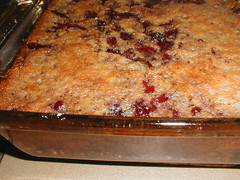
First, get a cow. Milk her, save some and make some butter. Then some soft white wheat. As in berries. Grain. Then get your daughter to grind it for you fresh. And pick some blackberries. Wild ones taste much better than the tame ones -- when they take the thorns out, some of the flavor goes too.
In this photo is a small square cobbler, about 8 inches. Not very big. The big one is made in the long pyrex dish like this. This is the recipe for the small, just double it for the big. If you have any more than four people eating it, or if you want some for tomorrow, make the big one.
Put a blob of butter in the dish and put in the preheating oven for it to melt. With butter, more is nearly always better. I'd estimate I use about, oh, half a stick or so, 4 TBS. When that is melted, put in a generous 2 cups of berries. I do not like runny cobbler so I also add some arrowroot powder -- a couple tablespoons. And some sugar. Maybe half a cup. Stir around a little and distribute evenly.
Then take a cup of the flour (add some rising to this -- a little baking powder [tsp], and a little salt 1/2 tsp]), a little less sugar, and a little less milk -- probably 3/4 cup of the last two. Mix dry ingredients, add milk, stir, pour over prepared berries, put in preheated 350 degree oven. It'll take it most of an hour to bake -- check at 45 minutes.

In the Oven
Originally uploaded by Contrary Goddess.
This recipe is the basic one my mother told me over the phone the first time I ever made this. "Oh, it's easy," she said, "a cup of each thing." I am much more fond of it with whole wheat flour and less sugar. My mom was a really good cook and I appreciate the relaxed attitude toward it that I was able to pick up from her.
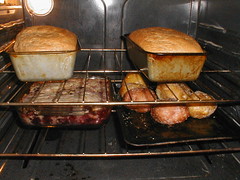
When we bake in the summer, we try to make the most of it, as you can see from the second photo. I have a number more food photos over on flickr if you are interested. Zero-miles food we're calling it as we take the photos.
Oh, and note that one day I was doing the usual multi-task kitchen thing when I was making the cobbler and I completely forgot to put the rising in it. And it was still good. Different. But good. It isn't how I'd choose to make it, but I'd eat it again.
Posted by
CG
at
7:04 PM
14
comments
Sunday, July 15, 2007
and now, back to our regular programming
Sort of.
The good news is we, well, husband, got the new axle in the van, and the oil changed, and the transmission fluid topped up. The bad news is, that didn’t cause it to stop what it is doing, which I swear is acting like the axle is bad. I guess it could be the other one, the one we put a new on in two years ago. It did cost us one mashed finger and a few hours out of the garden.
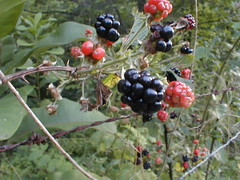
State of the Blackberries
Originally uploaded by Contrary Goddess.
The potatoes have made themselves and it looks like we have a good crop. We’ll harvest out of the patch for eating potatoes now. Later on we’ll pull up three or four milk crates full to the basement, and dig and hole the rest. They are primarily good fist sized potatoes. You could live on potatoes but you’d have to eat an awful lot of them. They say the Irish, during some of the worst exploitation by the British, ate 10 to 17 POUNDS of potatoes at a sitting. They were working. Working is a good thing.
We’ve got sweet corn ready to eat and the hard corn is coming right along. The Hickory King is over 12 feet tall, tasseling, and setting ears mostly over my head. We’re hopeful for the beans and squash in the corn patch too. Except for the damn enemy, the deer (she's in the photo below) who has eaten every patch of beans in the garden proper, and the sweet potatoes, and nibbled everything else. I think the neighbors are feeding her, taming her. Last spring we had a deer we caught by hand and we thought it had to be sick. This year, this one. I think it is that Bill, with emphysema, is entertaining himself between cigarettes.
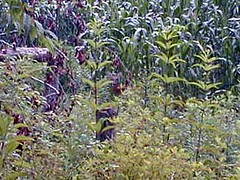
Enemy #47, 2B Dinner
Originally uploaded by Contrary Goddess. I saved seed from the fava beans today. Favas are interesting. Not in the usual pantheon of food, and yet a nice treat both to grow and eat. The first year we did them, we really didn’t know how to eat them. Now we know, shell, parboil, hull, THEN make them into something. Our favorites are probably a hummus-y sort of pate and, get this, take a bean so hulled, mash flat, and fry into a chip.
Here is my friend under the dish drainer.
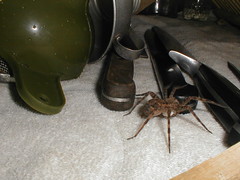
Pet Spider
Originally uploaded by Contrary Goddess. An assortment of chickens and chicks. We're in the middle of integrating the new chicks into the coop with the older chickens. I should cull some of them. I'll have the boys to kill in a few weeks.
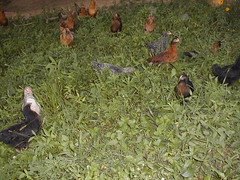
Chicks and Chickens
Originally uploaded by Contrary Goddess.
Posted by
CG
at
3:29 PM
13
comments
Labels: chickens, everyday life, food, foraging, garden
Tuesday, April 03, 2007
If I Were A Featherbed
If I were an evangelist of any sort, I’d be an evangelist that folks should grow some of their own food. No matter where they are, no matter who they are, no matter what, period. People would understand a whole lot more if they had just one row of beans. It doesn’t take much room, it can be decorative, it is certainly educational not to mention life altering.
I spent a large part of today getting things to not grow. People who don’t grow food probably don’t give much thought to how much a producer of food doesn’t want some stuff to grow, at least in certain places at certain times. And if soil is healthy and fertile, a lot of stuff is going to try to grow there. Stuff that will choke out your food and turn your orchard into an impenetrable thicket.
I spent a lot of time trying to kill stupid honeysuckle today. Now, I enjoy honeysuckle as much as anyone. I remember sucking the flowers as a kid and have done so as an adult, and the fragrance is intoxicating. But my stupid neighbor (we all have our moments, she just has more of them) planted honeysuckle on my fence near some fruit trees. So every year since then I’ve had to try to kill the damn stuff out. “You don’t like honeysuckle?” she asked in her little girl innocent voice when I mentioned I was trying to kill it one time a few years ago. That’s how I knew she’d planted it.
But that is how ignorant people are of growing food -- to plant an invasive climbing smothering vine near fruit trees. There was once a woman who blithely and condescendingly declared to us, “I know how to grow food,” as if growing food were an afterthought. One year she actually managed to plant a few beds. Beds that were quickly overrun with weeds. Months later she had no idea there were three carrots in the weeds -- because she didn’t know what carrots looked like even having seen them with their tops in the store. Yeah, she knows how to grow food, sure.
Of course, considering that most people can’t even cook a pea, planting one may seem quite the stretch. This is why I think people will starve to death with the end of the oil age. Not that they have to, but that if McD’s isn’t serving, they’ll stand at the drive-thru and wait, hoping.
Well, the wild mustard is coming on strong, and I noticed the fiddleheads up today so I should go pick some. The redbuds are blooming and waiting to be thrown into a salad. The other goats are getting their bags so there will be more babies this month. There’s lots and lots growing -- lettuce and radishes and spinach and kale and cabbage and lots of summer stuff too, still protected. The corn field has been glysophated in preparation to plowing, but the plow still needs a depth wheel (we‘ve been rehabbing an ancestral plow). The pear trees have been sprayed with teramycin against the fire blight. Maybe the honeysuckle has been checked a little in the front orchard, and maybe I’ll get that area “redone” this year -- tear the old fence (and roses) out, put a decorative split rail in (with perennials of my choosing), and make it more accessible to mowing which is the real answer to the honeysuckle anyway. Maybe.
But you can only do what you can do. Which isn’t everything that needs doing. And usually it isn't decorative.
the title is from a John McCutcheon song we had played at our wedding
Posted by
CG
at
7:52 PM
22
comments
Labels: ethics, everything, farm, foraging, life, right livelihood