Scratching
Originally uploaded by Contrary Goddess.
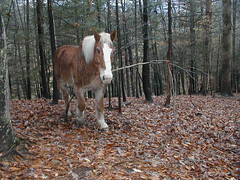
My horse had a major injury. Not something like a broken leg or anything, but something that anywhere else anyone else would have called the vet and the vet would have sutured it, at least, and probably started systemic antibiotics and likely analgesics and put on stall rest and who knows what else.
When I saw it, it scared me. If this became infected, it could become life threatening. And it was in a bad place, just under the flank, in such a place that there was air under the wound. The hole, scratched in there by a horse in love with scratching himself after he’d managed to break off the top of the tree, was about the size of a quarter. There was already a small edema under his belly.
The wound was draining serus and blood, mostly serus. It was not infected. I disinfected it but with some caution too because I didn’t want to introduce infectious agents where there had been none and I didn’t want whatever I used to disinfect it to then inhibit the healing of the wound. For example, do you know to always rinse off hydrogen peroxide because the same oxidation that disinfects the wound also inhibits healing. Of course, you have to rinse with something sterile. Boiled water works. That’s what I used, H2O2 and then boiled H2O. I wondered whether I should even have done that. Then I applied black salve (ichthamol ointment) generously. Then I watched and waited and took his temperature (to check for infection) and his pulse (to check for pain) twice a day and watched some more.
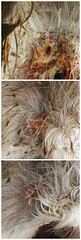
He never moved any differently because of the injury, never showed any sign of pain or infection. He was outside in his field the whole time. The wound wept for several days. The edema grew. His temperature and pulse and attitude and appetite never changed. Then the wound started filling in, just a little bit. And the edema didn’t change. Then, one morning, about a week into the injury, the edema was smaller. The horse had been laying down and I thought maybe that was why it was smaller. But it never increased again so maybe that pressure is one way that edemas under the belly are reduced.
In two weeks the edema was gone. The wound had been closed for several days at two weeks and at three except for a slight star of scar tissue you couldn’t tell it had ever been.
Here is the thing -- people in general, and doctors/veterinarians in particular, don’t know what the natural course of an event, a pregnancy, a wound, whatever, is anymore. I came right up against that with my pregnancies, where an OB insisted that just about every woman he attended would have died without his intervention but when quizzed it became painfully obvious that he’d never seen a natural labor. To him natural labor meant induction, pitocin, epidural, episiotomy, traction, hemorrhage and everything else. Intervention is so common that it is the norm and there isn’t a control group of natural healing to compare it with.
What I did to the horse was intervention and honestly might not have been helpful intervention. I tried to use my judgment and do my best at the time but it might have been that I interfered as much as a veterinarian would have. And it might have been that a veterinarian’s care would have sped the wound’s healing by . . . a couple days maybe. Stitches would have meant it was closed sooner, but perhaps it being open wasn’t a bad thing. Do you see the assumptions that get made when we take over the role of the body? We don’t really know any of it.
There is a place for alopathic medicine. There is a place for holistic medicine. But there ought to be an even bigger place for allowing what will happen to happen. Including, eventually, death.
Where the line is is always the question. And it becomes a question of where we put our trust -- outside or inside?
Like so many of my posts, this one is really a question, not an answer. But my bias is always for the inside job.
 My creation
Originally uploaded by Contrary Goddess.
These are wound photos at about 2 days, about a week, and about 2 weeks from date of injury.


